Product specifications, pricing, and availability are subject to change without notice. We make no warranties regarding product performance, longevity, or suitability for your specific needs.
Always verify specifications with the manufacturer and installer before purchase. Warranty terms are set by manufacturers and may have conditions not disclosed here. Battery performance degrades over time.
Installation guide · Site preparation
Quick answer
A plain guide to the concrete pad a home battery usually sits on — so your site is ready before your installer arrives. Treat the depths below as a general starting point; your installer and the battery's manufacturer confirm the exact pad for your site, soil and system.
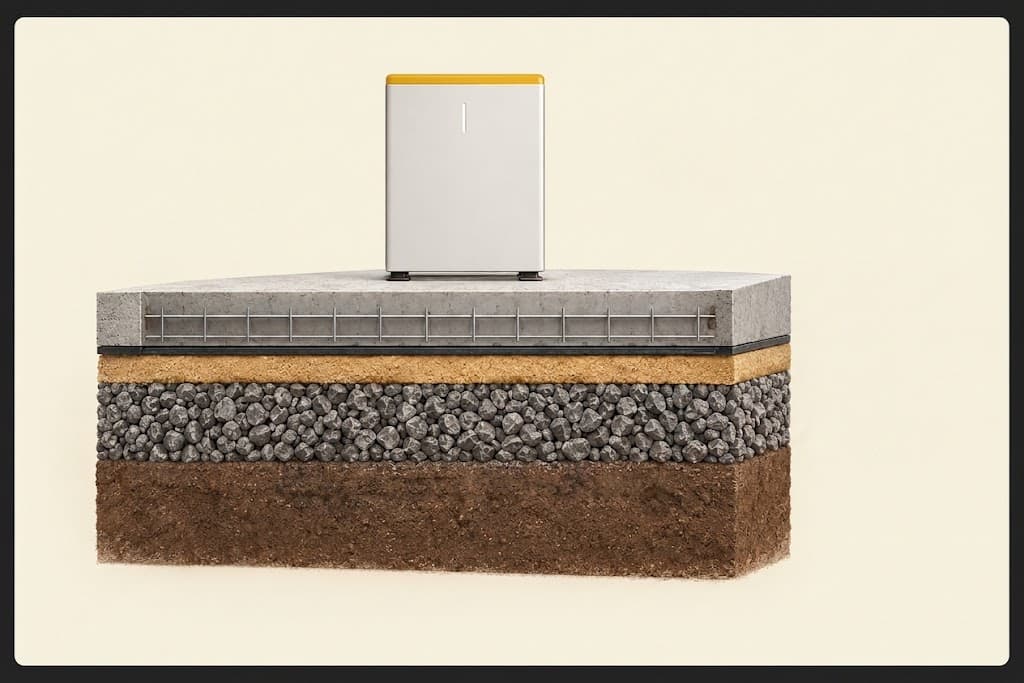
A six-step sequence a builder or competent DIYer can follow — or hand to your concreter.
At least 900 × 900 mm; 1200 × 1200 mm gives room to work and for future modules. Check the spot against the battery's clearance rules.
Lay and compact 100–150 mm of crushed rock so the ground underneath can't settle.
Screed 25–30 mm of coarse sand flat, then lay a damp-proof membrane over it.
Commonly 75–100 mm, and thicker (100–150 mm+) for heavier or multi-module systems — usually over steel mesh. Your installer or concreter confirms the depth and reinforcement for your battery's weight.
The finished surface must sit true. A battery on an out-of-level pad can void its warranty.
Grade the surrounds so water sheds away and can't pool or soften the ground beneath the base. Let the slab cure (commonly about a week) before the battery is mounted.
This is general preparation guidance, not a fixed specification. The right pad depends on your battery's weight and footprint, your soil, and local conditions — and every manufacturer (Tesla, Sungrow, BYD, Sigenergy and others) publishes its own pad and mounting requirements, some of which mount the unit on a wall bracket rather than a slab. Confirm the exact pad with your installer and the battery's installation manual before you pour. If in doubt, ask us and we'll match you with an installer who'll set it out for your site.
Bottom to top. Ranges are typical — the exact figures come from your installer and the battery's own installation manual.
A home battery is heavy — a single unit is often 100–150 kg, and multi-module systems far more. The heavier the system, the thicker the slab. Your installer confirms the depth for your battery.
Lighter single battery
~75–100 mm
Larger single / two-module
~100 mm
Heavy multi-module system
100–150 mm+
Hand this guide to your concreter or landscaper, or keep a copy for the day.
Get a quote from an installer from our network that covers your area. You choose whether to act on it. No obligation.
Solar Battery Perth · solarbatteryperth.com.au · independent WA battery comparison · indicative site-preparation guidance, not an engineering specification · confirm with your installer and the manufacturer's installation manual.